What Is Task-Based Learning? A Practical Guide for EFL Teachers
Picture this. You spend 20 minutes of a lesson presenting the second conditional. Students nod. They complete the practice exercises. Most of them get it right. You feel okay about the lesson.
Then, two weeks later, you overhear two students trying to discuss a hypothetical situation and they’re just… not using it. At all. Back to present simple. As if the second conditional lesson never happened.
This isn’t unusual. It’s actually kind of the default outcome of a lot of well-planned, well-delivered grammar instruction. And task-based learning, at its core, is a response to exactly this problem.
What Is Task-Based Learning, Actually?
Task-based learning (TBL – sometimes written task-based learning, sometimes called TBLT, for task-based language teaching) is a teaching approach where the lesson is built around completing a communicative task rather than studying a specific grammar point or vocabulary set.
The idea is that students use the language to do something – reach an agreement, solve a problem, share information that only they have – and the language learning happens through that process. Grammar and form come afterwards, as a response to what students actually produced and what they needed to express.
It’s a pretty direct challenge to the dominant model in EFL teaching, which is PPP: Present the language, Practice it in controlled exercises, Produce it in a freer activity at the end. TBL basically takes that order and reverses it. Or collapses it. Depending on how you implement it.
I’ll be honest – the boundary between “proper TBL” and “a lesson that starts with a communicative activity” is blurrier than some methodology textbooks suggest. In practice, a lot of what teachers call TBL is closer to “test-teach-test”: throw students at a task, see what they can and can’t do, then address the gaps. That’s a fine way to teach. Whether you call it TBL is somewhat academic.
What Counts as a Task? (And What Doesn't)
This trips people up.
A task, in the TBL sense, has a few key features. It has a real communicative goal – not “use the target language correctly” but something more like “reach a decision” or “find out information” or “create something together.” The focus is on meaning, not on form. And there’s a clear outcome – you can tell when it’s done.
A gap-fill exercise is not a task. Writing five sentences using the past perfect is not a task. “Discuss the advantages and disadvantages of social media” is borderline – it depends whether students are genuinely exchanging views they hold or just performing an exercise.
Something like this is a task: “You and your partner each have half the information about two candidates for a job. Don’t show each other your cards. Ask questions, share what you know, and decide together which candidate to hire.”
There’s a real information gap. Students actually need to communicate to complete it. They’ll have to ask questions, respond, negotiate, explain. All of that requires language — but the language is in service of the goal, not the point of the exercise.
One more example from the BOOKR Class teaching approaches article, which handles this well: “In pairs, look at the list of 10 possible birthday presents and agree on the TOP 5.” Simple, but it works. Students are using language to get something done. That’s the whole game.
How a TBL Lesson Is Structured
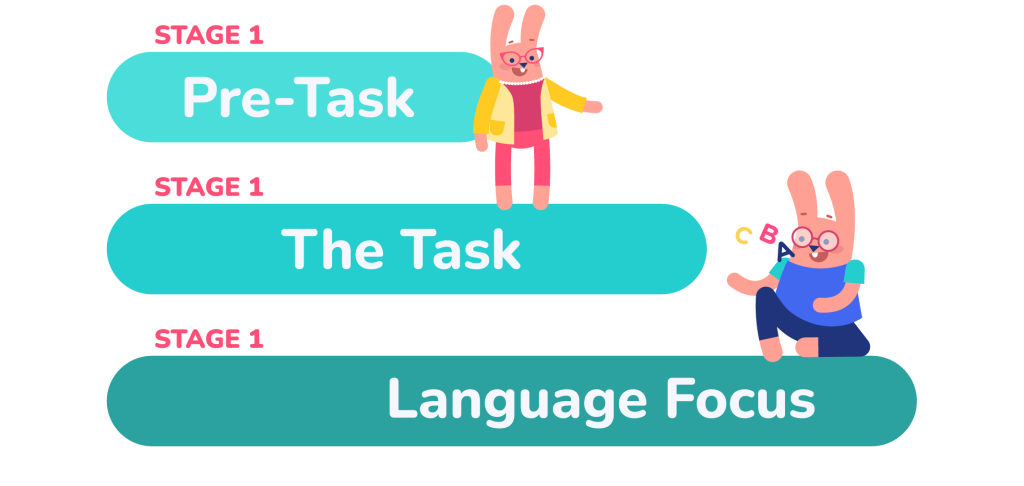
Jane Willis’s framework from the 1990s is still the clearest way to explain TBL. Three stages.
Pre-Task
Before the task, the teacher sets up the topic and activates relevant knowledge. Not a grammar presentation – more like briefing. You might show students an example of the task being completed, work through some useful vocabulary, or just have a quick whole-class warm-up about the topic.
This stage gets undervalued. Students who feel completely lost when the task starts don’t communicate – they go quiet, or they switch to L1, or they produce something so minimal it’s not really useful for anyone. A decent pre-task phase changes the quality of what happens next.
The Task Itself – and What Happens Around It
Students do the task, usually in pairs or small groups. The teacher doesn’t correct in the moment. That’s important. Intervening to fix errors while students are mid-communication breaks the whole point of the exercise. You circulate, you listen, you note things down — but you let it run.
After the task, there’s a planning phase where students prepare to report what they discussed or decided to the rest of the class. And then an actual report – groups share with the class. The reporting creates a real audience and a real purpose for the communication, which changes how students approach the planning.
This is probably where TBL departs most sharply from what most classrooms actually do. The idea that students should prepare to present their thinking to each other – not just to the teacher – adds a layer of accountability that tends to raise the quality of what they produce.
Language Focus
Right at the end. The teacher draws attention to structures and language patterns that emerged during the task – both things students used well and things they struggled with. Ideally using actual examples from what the class produced.
This sequence matters because by the time you get to the grammar focus, students have already experienced needing that language. They’ve felt the gap. That noticing – the moment of I didn’t know how to say that – is a much more effective hook for language learning than introducing the same structure cold at the start of a lesson.
TBL vs PPP
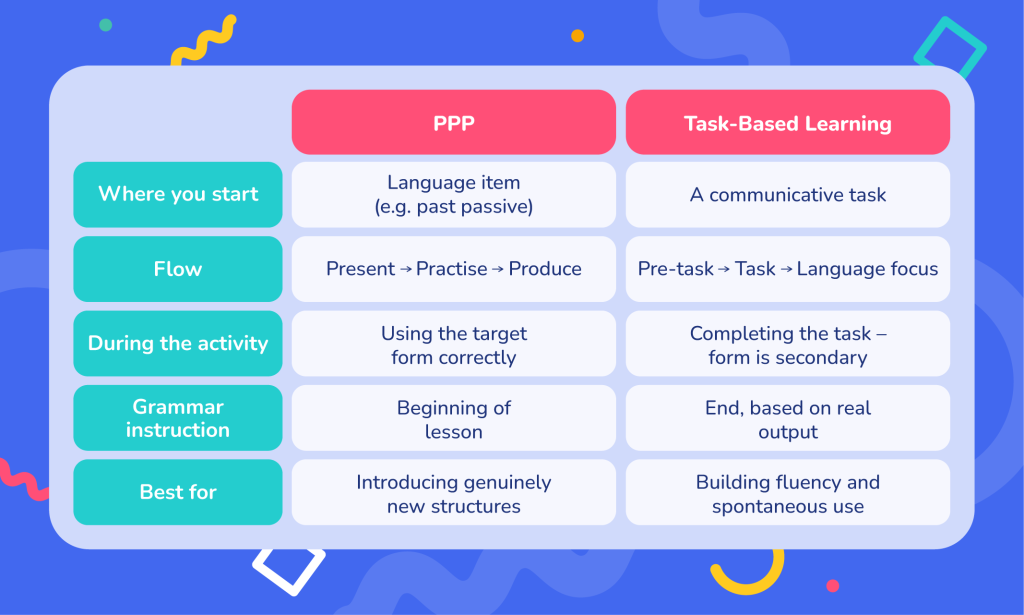
Worth laying out side by side.
| PPP | Task-Based Learning | |
| Where you start | Language item (e.g. past passive) | A communicative task |
| Flow | Present → Practise → Produce | Pre-task → Task → Language focus |
| During the activity | Using the target form correctly | Completing the task — form is secondary |
| Grammar instruction | Beginning of lesson | End, based on real output |
| Best for | Introducing genuinely new structures | Building fluency and spontaneous use |
Neither is universally better. PPP is more predictable, easier to plan, and works well when students genuinely need to encounter new language for the first time. TBL tends to work better once students have some language already and need to actually be able to use it under real conditions.
A lot of experienced teachers end up mixing both, more or less consciously – starting with a task to see what students can do, then addressing gaps, then returning to practice. The label matters less than the intention.
Does It Actually Work?

The research case for TBL is reasonably strong. Not overwhelming – methodology research in language teaching rarely is – but consistent enough that there’s something there.
The core argument is about noticing. When students are trying to communicate something and realise they can’t quite express it, they actively register that gap. That moment of reaching for language you don’t quite have turns out to be a more effective trigger for acquisition than practising language you’ve been handed. This is why two weeks after the PPP lesson on the second conditional, students still revert to present simple – they practised it, but they never actually needed it for anything.
There’s also something simpler: students who are focused on completing a task are more engaged than students doing controlled exercises. This isn’t true 100% of the time – plenty of students find task-based activities stressful or unfamiliar – but on average, communicative tasks tend to hold attention better.
One caveat that’s probably worth flagging: a lot of TBL research is done in fairly ideal conditions – small groups, well-designed tasks, teachers who are trained in the approach. Results in larger classes with mixed motivation and a rigid exam syllabus are harder to replicate. So “TBL works” is true in a qualified way. It works when it’s done well, which is also true of PPP.
Where TBL Gets Difficult

The challenges are real. Worth taking seriously before you go and restructure your entire scheme of work.
TBL requires a more flexible teacher. You can’t fully predict where a task will go. Students might communicate in ways that surface language needs you weren’t planning to address that lesson. The grammar focus at the end depends on what actually happened, not what you planned to happen. For teachers who find security in a detailed lesson plan with a clear structural destination, that’s uncomfortable.
Classroom management is also trickier. Pair and group tasks create noise. Students sometimes go off-task in their L1. Weaker students can hide behind stronger partners. None of these are insurmountable problems, but they require thought.
And then there’s the exam situation. This is the one that genuinely constrains a lot of teachers. If your students are sitting a paper that tests discrete grammar knowledge in controlled conditions, you can’t just abandon PPP for TBL and hope for the best. TBL builds the kind of communicative competence that supports exam performance in the long run – but “in the long run” doesn’t help students who have a test in six weeks.
Most teachers in exam-focused contexts end up using TBL selectively. One task a week. End-of-unit consolidation activities designed around a task framework. It doesn’t have to be all or nothing.
A Quick Note on BOOKR Class
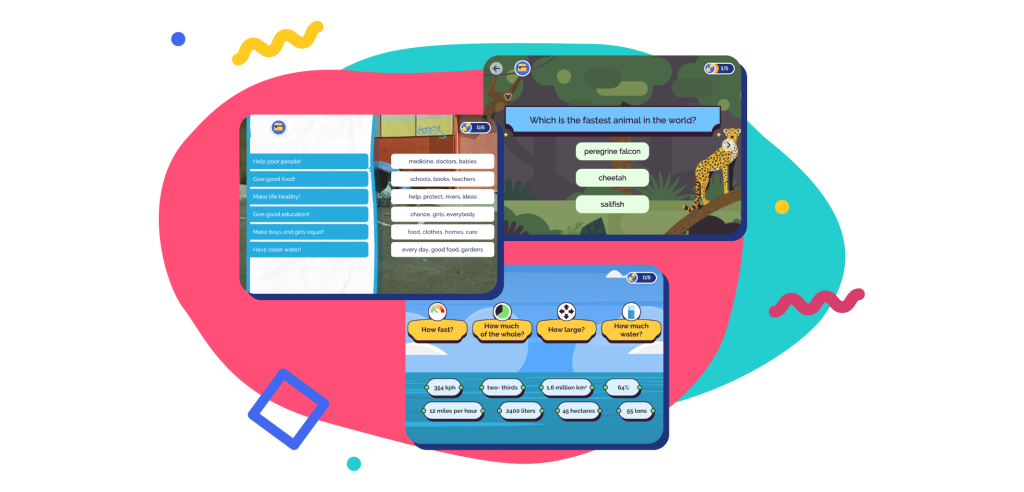
One practical thing: a lot of the richest material for task-based activities comes from reading. A student who’s read an engaging levelled story – or a CLIL science text – about something genuinely interesting has content to work with. The discussion task, the problem-solving task, the creative follow-up – all of that is much more productive when students have real ideas to bring to it.
BOOKR Class has a library of levelled interactive books that work well here, especially in a flipped classroom setup – students read for homework through the app, the Teacher’s Dashboard shows you who engaged with what, and the class time is free for the task itself. That’s more useful than trying to use a coursebook dialogue as the stimulus for a TBL activity.
Anyway, that’s a digression. The point is: task-based learning doesn’t operate in a vacuum, and what you give students to read and think about before the task matters quite a bit.
Frequently Asked Questions
What is task-based learning in simple terms?
Students complete a real communicative task first – agree on something, exchange information, solve a problem – and the language instruction comes after, based on what they needed to do it. The emphasis is on using language for a real purpose rather than practising it in controlled conditions.
Is TBL suitable for beginners?
Yes, with adjustments. Lower-level students need more support in the pre-task phase, simpler tasks with concrete outcomes, and more time. But even A1 students can do basic information-gap or opinion tasks. The principle scales – the task design changes, not the approach.
How is TBL different from communicative language teaching?
CLT is the broader philosophy – language teaching should develop communicative competence, not just grammatical accuracy. TBL is one specific methodology within that tradition. All TBL is CLT, but not all CLT is TBL.
My students hate group activities. Can TBL still work?
Honestly, this is one of the tougher challenges. Some student populations – particularly those used to teacher-fronted instruction – find task-based activities frustrating or pointless. Building in clearer task structures, shorter tasks to start with, and explicit explanation of why you’re doing this can help. But it does require buy-in from students, and that takes time to develop.
Can I use TBL if my school uses a coursebook?
Yes. Most coursebook production activities can be reframed as tasks. Some teachers start with the final communicative activity, see what language gaps emerge, and then work through the unit’s grammar and vocabulary content as a response. It’s a bit backwards from how coursebooks are designed, but it works.
The Bottom Line
Task-based learning is worth understanding, not because it’s the right approach for every classroom, but because it reframes something fundamental about what language lessons are for. The question it asks – are students using language, or just practising it? – is one that’s worth sitting with regardless of what methodology you end up using.
It’s messy in practice. It doesn’t always fit exam timelines. Not every student takes to it immediately. But when it works – when a task generates the kind of focused, purposeful exchange where students are genuinely reaching for language to express something — it’s more useful than most things you can do in 45 minutes.
That’s about as much as can be said without just watching you try it.
BOOKR Class is a digital reading platform for English language learners, with a levelled book library and Teacher’s Dashboard designed to support flexible teaching approaches including TBL and flipped classroom models. More at bookrclass.com.


You might also like...
What Is Content and Language Integrated Learning (CLIL)? A Practical Guide for Teachers
BOOKRClass | 20.05.2026.